

Eat Real Food
By Vinnie Kape
Registered School Dietitian
Utica Community Schools
“Eat real food.” This simple three-word message reflects not only the content of the latest dietary guidelines, but also its form. The 2025–2030 guidelines were published in just ten pages, making them more accessible to the average American than any prior edition.
Alongside the document, officials released a new visual: an inverted food pyramid emphasizing proteins, dairy, healthy fats, fruits and vegetables at the top, with whole grains on the bottom. The design nods to the original Food Guide Pyramid of the 1990s, following decades of evolution from MyPyramid to MyPlate. The return to a pyramid signals a shift in focus away from proportions toward food processing, specifically whole foods.
That focus is reinforced throughout the recommendations. Protein is now a priority at every meal and is encouraged in forms without additives. Fruits and vegetables are recommended in their original form, with allowances for frozen, dried, or canned versions without added sugars. Grains are specified as whole and fiber-rich. Dairy guidance now includes full-fat options, and healthy fats are encouraged from whole foods such as meat, poultry, and eggs. Words like “whole” and “original” appear repeatedly, underscoring the document’s core message.
This message becomes more complicated with nutrients like sodium and saturated fat. While intake limits remain, sodium and saturated fat are framed differently than in previous guidelines. Salt is explicitly suggested as a flavoring for proteins and produce, and many foods identified as sources of healthy fats naturally contain saturated fat.
While these ideas appear contradictory, they align with the broader message of the guidelines: the health risks associated with sodium and saturated are viewed more significantly in highly processed foods than in whole foods.
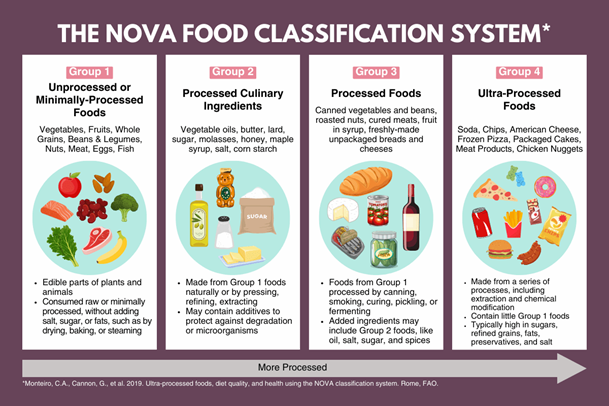
This framing parallels public scrutiny of ultra-processed foods (UPFs). Although the term “ultra-processed” is not used, references to “highly processed” foods appear throughout the document. The challenge in this area is the lack of a universally accepted definition. Classification systems like NOVA attempt to categorize foods by processing level, but are not intuitive. Some foods labeled as ultra-processed are associated with negative health outcomes, while others, like yogurt or whole-grain products, are consistently linked to positive ones. This nuance remains unresolved, prompting the FDA to request public input toward a more uniform definition.
School nutrition operators are paying close attention to these developments. The Dietary Guidelines for Americans serve as the foundation for all federal nutrition policies, including regulations governing the school meal programs. School nutrition professionals translate these guidelines into meals that students eat daily.
While these guidelines focus on whole foods, schools operate differently from home kitchens. School menus are not just shaped by nutrition guidance, but also by budgeting, staffing, and equipment. What is communicated simply to consumers must be executed precisely in schools.
This is where tension shows up. Many whole food options, especially protein foods, are more expensive and more labor-intensive. As a result, schools often rely on processed items to remain compliant and operational, even when broader messaging may encourage the opposite.
For operators, implementation means bridging the gap between simple messages and complex systems. As future polices are shaped by this edition of the guidelines, flexibility and practical support will be essential if schools are expected to carry out their intent.


Comments